To treat with excessive leniency, generosity, or consideration

I was not particularly indulgent with the Catholic Church and Pope Inquisitor, when I last discussed plenary indulgences on here. (Quoting Hitchens doesn’t count.)

I see that the indulgences are newsworthy again, with some discussion this week of a piece in the Times. I’m mostly amused that part of the point of the piece is that most Catholics apparently don’t know, or don’t understand what the indulgences are. How hard is it to explain that if you sin, you need to get forgiven (confession), but you still need to “do the time” for your sin by hanging out for some period of time in Purgatory, and that the indulgences can carve off some or all of that penalty box time?

Apparently pretty complicated, since the Church apparently has a manual on the subject, and a FAQ. Or, as the article says:

The indulgence is among the less noticed and less disputed traditions to be restored. But with a thousand-year history and volumes of church law devoted to its intricacies, it is one of the most complicated to explain.

I am kind of tempted to buy the manual, just to do a line-by-line comedy deconstruction.

I was also amused by John Crowley’s description of the time he was granted one:

The Vatican ambassador to the US, the Apostolic Nuncio, visited the University of Notre Dame across the road from my high school, and the Nuncio came to address my school in an assembly (boys on one side, girls on the other). He brought with him, whether as spiritual power or in the form of some physical juju I don’t know, the ability or right to give Papal Plenary Indulgences. I don’t remember at all what he said, but at the end, after we had taken a moment to prepare ourselves spiritually, he dispensed or provided it to us. Thus was wiped away every sin committed in our lives, and also every nasty trace of forgiven sins still darkening our souls and meriting us an unspecified stay in Purgatory (just as Dad forgives your trespasses but you still get the spanking). I immediately negated this advantage by returning to those indulgences (other sense) that at 15 I was prone to.

This kind of foolishness seems to be making me less angry this time around, and more amused. It’s like Ratzinger has chosen to grow the flock by emphasizing the mysterious, mystical aspects of the religion. Costumes, dead languages, pomp, ceremony, mysticism, etc. Making it a show puts bums in seats, apparently.

But for Catholic leaders, most prominently the pope, the focus in recent years has been less on what Catholics have in common with other religious groups than on what sets them apart — including the half-forgotten mystery of the indulgence.

Me, I say, why not push harder to get people in. Coupons are good for that, I hear.
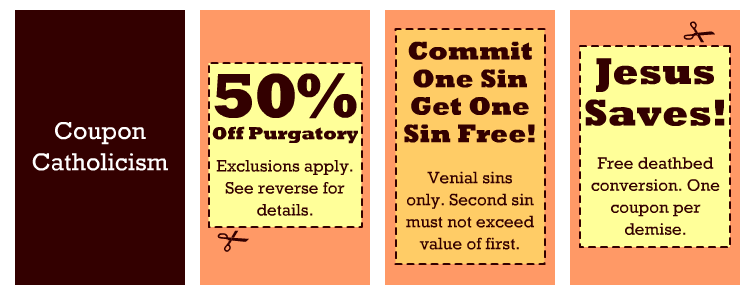
Catholic Coupons

Tags: ,,,,

4 Responses to “To treat with excessive leniency, generosity, or consideration”

  1. Biff Says:
    1

    I remember reading/hearing somewhere (possibly a TED talk) that indulgences are basically why the printing press took off so rapidly – printing and selling indulgences was highly profitable.
    Do you find it ironic that your (what some would consider) book worship can be traced back to the church that you detest?

  2. Mr. McLaren Says:
    2

    “The history of the Gutenberg Bible is the subject of considerable scholarly debate. The earliest dated specimens of printing by Gutenberg are papal indulgences (notes given to Christians by the Pope, pardoning their sins) issued in Mainz in 1454.”

    “Johannes Gutenberg – inventor, goldsmith – and businessman. Like any good businessman, Gutenberg was constantly on the lookout for market opportunities. He diagnosed the market’s need for mass produced writing. Like any good businessman, Gutenberg borrowed money to research a solution for this gap in the market. He produced the printing press, with innovations in the use of movable metal type. And like any good businessman, he was good at marketing. His first publication was thus the bible, the world’s first, and still greatest, bestseller. But Gutenberg had an eye on where the real money was – Indulgences. Indulgences were rich people’s way of buying forgiveness from God for their sins, and the Church’s way of funding religious wars. Gutenberg wanted to mass produce these indulgences for the Church, in effect a license to print money.”

    “Onto this scene came Johannes Gutenberg, a profit-minded goldsmith from Southern Germany. Ben Franklin he was not. His inspiration for the reinvention of movable type (this time cast in metal) was not the betterment of his society, nor the advancement of human knowledge. His motivation was personal profit. He hoped to get rich by printing the Church’s ever-popular indulgences. These handy slips of paper could be bought by a sinner to gain dispensation from any discretion, past or future.

    So popular were indulgences that soon Gutenberg was printing up to 200,000 of them in one run.”

    All quotes cited here.

    I always thought the Bible was one of the drivers for the printing press, but it looks like you’re right that it was indulgences even before that.

    So yeah, there’s some irony there.

    Of course, you can split a lot of hairs there–the written word and the book predate movable type, so we’re really only crediting indulgences with moving along the production process. And it’s really fiction that I love, more than the generic book (I can love non-fiction books, but it’s much less common), which predated the press, was suppressed for a long time during the primacy of the Church, and then came back much later. And I can live with the irony anyway–kind of like how I love the Internet, even though it started as a military thing. An American military thing, even.

  3. Sharon Says:
    3

    My grandfather got a certificate form the Pope some decades back that said if he or any member of his family utters the name “Jesus” on their deathbed, they get an automatic plenary indulgence. I am holding this in my back pocket to use on a technicality in case my atheism doesn’t pay off. The certificate doesn’t say anything about having to believe anything. Just say the name, and you’re in. I forgot all about it until I read this.

  4. Mr. McLaren Says:
    4

    I don’t think it counts unless you’ve already confessed–it just gets you out of purgatory if you’re otherwise in good order. So you’ll want that, and a quick (but honestly repentent) deathbed confession, I would think, to cover your bases.

Leave a Reply

You can use these tags: <a href="" title=""> <abbr title=""> <acronym title=""> <b> <blockquote cite=""> <cite> <code> <del datetime=""> <em> <i> <q cite=""> <strike> <strong>

Quicktags:

The odds are very good that comments submitted with JavaScript turned off will be flagged as spam.