
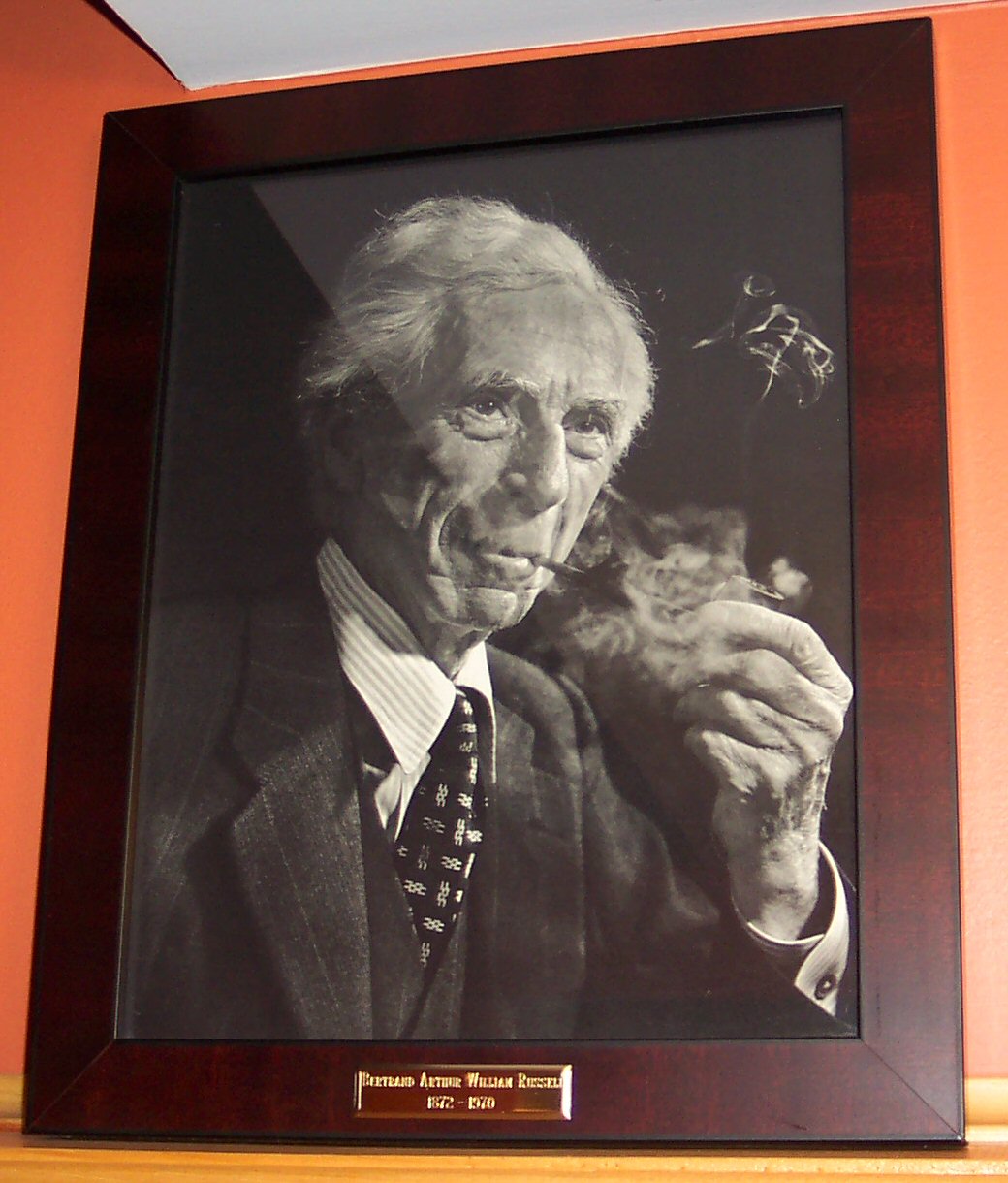
So, one of the things I told myself I would do in 2006 is spend a lot more time writing about Bertrand Russell [wikipedia], or rather about his works, on this blog. Russell, you may recall, is one of my biggest heroes, to the extent that there are multiple images of him around the house.
Writing about Russell is going to scare a bunch of my readers, but I have a secret plan to slowly draw them into the glory by starting with some of Russell‘s shorter and wittier works. That way, by the time we get around to the Big Ideas people will hopefully be hooked. Yes, that’s right, I’m going to use the “The first bag is free” marketing strategy to hook you.
With that in mind, we’re going to start by looking at Russell‘s essay “In Praise Of Idleness“, the text of which is available online. I’m going to pull some choice chunks for quoting and riff on them a bit, but you should pop over and read the whole thing–it’s not that long, and in some ways Russell is a lot like Eddie Izzard: you don’t get all the funny unless you get everything in the right order and with the right pacing.
Let’s start looking with paragraph 3, where Russell continues to argue that savings are the cause of many evils (he’s just warming up, later he’s really going to try to convince you that idleness is good for you):
One of the commonest things to do with savings is to lend them to some Government. In view of the fact that the bulk of the public expenditure of most civilized Governments consists in payment for past wars or preparation for future wars, the man who lends his money to a Government is in the same position as the bad men in Shakespeare who hire murderers. The net result of the man’s economical habits is to increase the armed forces of the State to which he lends his savings. Obviously it would be better if he spent the money, even if he spent it in drink or gambling.
If you read that in context, it’s obvious that there’s some dry British humour going on, but the point is perfectly valid for all that. Really this isn’t too far off the idea that got Thoreau into the slammer, except with government savings bonds in the place of taxes. Of course these days we are almost explicitly taught not to consider the consequences of our actions, particularly in respect to our relationship with government, so it might astound people to see this line of reasoning.
In these days, however, no one will deny that most enterprises fail. That means that a large amount of human labor, which might have been devoted to producing something that could be enjoyed, was expended on producing machines which, when produced, lay idle and did no good to anyone. The man who invests his savings in a concern that goes bankrupt is therefore injuring others as well as himself. If he spent his money, say, in giving parties for his friends, they (we may hope) would get pleasure, and so would all those upon whom he spent money, such as the butcher, the baker, and the bootlegger.
I like to call this the ‘MacFarlane’ thesis. I have to wonder what kind of satire Russell could have produced had he been around to see the first Internet bubble (yes, that’s right, I said “first”–and if you had your eyes open that would be no shock to you), and to hear about the Information Economy and all the other bubble buzzwords. Actually, I’d be even happier to hear what he would make of the cybersocialst dreams: the Reputation Economy, the GPL, Stross’ post-scarcity algamics, etc.
All this is only preliminary. I want to say, in all seriousness, that a great deal of harm is being done in the modern world by belief in the virtuousness of work, and that the road to happiness and prosperity lies in an organized diminution of work.
“But seriously folks…” The writing is satirical, but the point is serious. Russell is about to argue for the continuing reduction on the amount of human work, and he’s doing it in the face of the Protestant work ethic. It would be an even more uphill battle in North America’s white collar world these days, where people choosing the 80-hour work week are somehow respected. It’s an even more important argument in blue collar North America, where some people have to do an 80-hour work week to keep their family in basic necessities.
Work is of two kinds: first, altering the position of matter at or near the earth’s surface relatively to other such matter; second, telling other people to do so. The first kind is unpleasant and ill paid; the second is pleasant and highly paid.
Again, I wonder what Russell would have thought of “knowledge workers”–I suspect that he would have just included them in the redundant layers of the second kind of work.
He’s wrong though, in that the second kind of work is only pleasant for the people at the top of the hierarchy. For everyone who has a boss, work is not necessarily pleasant, although white collar work is probably always more pleasant than “real” work.
The second kind is capable of indefinite extension: there are not only those who give orders, but those who give advice as to what orders should be given. Usually two opposite kinds of advice are given simultaneously by two organized bodies of men; this is called politics. The skill required for this kind of work is not knowledge of the subjects as to which advice is given, but knowledge of the art of persuasive speaking and writing, i.e. of advertising.
This may be the most concise summary I’ve ever seen of how modern government changed from rule by ruler types to rule by marketing. It’s also a nice backhanded answer to those people who say “a good manager can manage anything–he doesn’t need domain knowledge”.
Russell then wants to make sure you understand that the idleness he’s for isn’t that of the idle rich:
These landowners are idle, and I might therefore be expected to praise them. Unfortunately, their idleness is only rendered possible by the industry of others; indeed their desire for comfortable idleness is historically the source of the whole gospel of work. The last thing they have ever wished is that others should follow their example.
Interesting to hear an Earl of the Peerage talking in the tongue of class warfare, no?
From the beginning of civilization until the Industrial Revolution, a man could, as a rule, produce by hard work little more than was required for the subsistence of himself and his family, although his wife worked at least as hard as he did, and his children added their labor as soon as they were old enough to do so. The small surplus above bare necessaries was not left to those who produced it, but was appropriated by warriors and priests. […] A system which lasted so long and ended so recently has naturally left a profound impress upon men’s thoughts and opinions. Much that we take for granted about the desirability of work is derived from this system, and, being pre-industrial, is not adapted to the modern world. Modern technique has made it possible for leisure, within limits, to be not the prerogative of small privileged classes, but a right evenly distributed throughout the community. The morality of work is the morality of slaves, and the modern world has no need of slavery.
Now we’re starting to really cut into it–the fact of the matter is that, even at the time this was written, it was possible for society to distribute labour in such a way that everyone should have had a shot at a reasonable chunk of leisure. If anything, this should be more true today. And since that’s true, we really need to look at the conventional wisdom that sees virtue in excessive work.
The conception of duty, speaking historically, has been a means used by the holders of power to induce others to live for the interests of their masters rather than for their own. Of course the holders of power conceal this fact from themselves by managing to believe that their interests are identical with the larger interests of humanity.
I love that he can lay the blame, with diamond sharp precision, but that he sees clearly enough to understand that the “holders of power” are fooling not just their subservients, but themselves as well.
He then lays out a case that WWI proved that people don’t need to work as hard as they do. It’s a pretty solid argument. It leads to this:
If, at the end of the war, the scientific organization, which had been created in order to liberate men for fighting and munition work, had been preserved, and the hours of the week had been cut down to four, all would have been well. Instead of that the old chaos was restored, those whose work was demanded were made to work long hours, and the rest were left to starve as unemployed. Why? Because work is a duty, and a man should not receive wages in proportion to what he has produced, but in proportion to his virtue as exemplified by his industry.
This actually drives me nuts in my line of work as well. You see it all the time. Person A is given a chunk of work to do that would take the theoretical average man 8 hours to perform. He does it in 4 hours, and then spends 4 hours surfing the web. Person B is given the same work, and it takes him 12 hours. He is seen to be in the office at 8AM, and stays until 9PM (he wastes at least an hour in there). Somehow management thinks that person B deserves a reward for putting in “all that time and effort” and that person A deserves a reprimand for “wasting company resources”. It makes me crazy.
You can see why this is–the employer still thinks in terms of pay-per-hour, so sees person A as being paid for 8 hours of work but only doing 4, while they see person B as being paid for the same 8 hours, but turning in 12. What’s missing, and what makes this insane, is a connection between time and productivity–employers shouldn’t be thinking in terms of the number of hours they pay for, but in terms of the amount of output they want to get per amount of money; the number of hours taken to reach that output shouldn’t be a direct factor.
This is the one thing I always preferred about contract work–it’s always on a cost-per-deliverable basis, rather than on a cost-per-hour basis. Employers should see this as a plus, since there’s no incentive to drag your feet, as there is in the per-hour scenario, but that’s where we run into what Russell calls “superstition” about the moral duty to work.
(Fortunately, working from a home office, no one can see how long it takes me to do my work, so I am always judged on my output, not on my hours of effort. This is the single greatest benefit of being a remote worker.)
Russell then goes on to work through a thought experiment where a machine doubles the number of items a worker can produce. He walks through the likely result of half the workers being unemployed, and compares it to the more sensible result of all the workers just working half as much, for the same pay:
There is, in the end, just as much leisure as on the other plan, but half the men are totally idle while half are still overworked. In this way, it is insured that the unavoidable leisure shall cause misery all round instead of being a universal source of happiness. Can anything more insane be imagined?
No, it can’t. The sad part is that the owner of the factory doesn’t see it as insane–he sees a chance to have the same production with half the man-power cost. In our society, and with the ideas we are raised in without explict awareness (like water to a fish), you almost can’t blame him.
The idea that the poor should have leisure has always been shocking to the rich. In England, in the early nineteenth century, fifteen hours was the ordinary day’s work for a man; children sometimes did as much, and very commonly did twelve hours a day. When meddlesome busybodies suggested that perhaps these hours were rather long, they were told that work kept adults from drink and children from mischief.
And people goggle at me when I (a white-collar, papered professional) make relatively mild statements about the utility of organized labour. Sigh.
Let us, for a moment, consider the ethics of work frankly, without superstition. Every human being, of necessity, consumes, in the course of his life, a certain amount of the produce of human labor. Assuming, as we may, that labor is on the whole disagreeable, it is unjust that a man should consume more than he produces. Of course he may provide services rather than commodities, like a medical man, for example; but he should provide something in return for his board and lodging. to this extent, the duty of work must be admitted, but to this extent only.
Well, “everyone must put in at least as much as they take out” seems only logical to me. I wonder though if the modern right, seeing that paragraph would run away screaming that Russell was a communist or something.
If the ordinary wage-earner worked four hours a day, there would be enough for everybody and no unemployment — assuming a certain very moderate amount of sensible organization. This idea shocks the well-to-do, because they are convinced that the poor would not know how to use so much leisure. In America men often work long hours even when they are well off; such men, naturally, are indignant at the idea of leisure for wage-earners, except as the grim punishment of unemployment; in fact, they dislike leisure even for their sons.
It was true in 1932, it is just as true today. The tinfoil hat part of me also wonders if the ruling class actively encourages this continued perception of the moral value of work, because people with leisure time often spend much of it thinking about things like the role of government, or educating themselves enough to make it troublesome to lead them. The manfacture of consent among the governed is surely easier among folk with less leisure, who are more apt to be tired and disinclined to research, doubt, or argue.
But what will happen when the point has been reached where everybody could be comfortable without working long hours?
In the West, we have various ways of dealing with this problem. We have no attempt at economic justice, so that a large proportion of the total produce goes to a small minority of the population, many of whom do no work at all. Owing to the absence of any central control over production, we produce hosts of things that are not wanted. We keep a large percentage of the working population idle, because we can dispense with their labor by making the others overwork. When all these methods prove inadequate, we have a war
Ouch. I mean, just “ouch”.
The fact is that moving matter about, while a certain amount of it is necessary to our existence, is emphatically not one of the ends of human life. If it were, we should have to consider every navvy superior to Shakespeare. We have been misled in this matter by two causes. One is the necessity of keeping the poor contented, which has led the rich, for thousands of years, to preach the dignity of labor, while taking care themselves to remain undignified in this respect. The other is the new pleasure in mechanism, which makes us delight in the astonishingly clever changes that we can produce on the earth’s surface. Neither of these motives makes any great appeal to the actual worker. If you ask him what he thinks the best part of his life, he is not likely to say: ‘I enjoy manual work because it makes me feel that I am fulfilling man’s noblest task, and because I like to think how much man can transform his planet. It is true that my body demands periods of rest, which I have to fill in as best I may, but I am never so happy as when the morning comes and I can return to the toil from which my contentment springs.’ I have never heard working men say this sort of thing. They consider work, as it should be considered, a necessary means to a livelihood, and it is from their leisure that they derive whatever happiness they may enjoy.
Obviously there’s a bit of rhetorical exaggeration going on here, as I certainly have heard from craftsmen (who I am sure Russell would count as part of the labour class) who are delighted to wake each morning and attack their craft. More frighteningly, I know a disturbing number of otherwise intelligent people who define themselves almost entirely in terms of their employment, and who consequenly devote an unholy amount of time to it, often at the expense of an enriching social or family life.
The underlying point, however, still stands, that there are other better things a man can aspire to besides doing hours of hard work.
It will be said that, while a little leisure is pleasant, men would not know how to fill their days if they had only four hours of work out of the twenty-four. In so far as this is true in the modern world, it is a condemnation of our civilization; it would not have been true at any earlier period. There was formerly a capacity for light-heartedness and play which has been to some extent inhibited by the cult of efficiency.
This might be the saddest bit in this essay. The idea that we are turning from a playful and light-hearted society to some grim, Kafkaesque mechanistic culture is both terrifying and frankly, heart-rending.
Broadly speaking, it is held that getting money is good and spending money is bad. Seeing that they are two sides of one transaction, this is absurd; one might as well maintain that keys are good, but keyholes are bad. Whatever merit there may be in the production of goods must be entirely derivative from the advantage to be obtained by consuming them. The individual, in our society, works for profit; but the social purpose of his work lies in the consumption of what he produces. It is this divorce between the individual and the social purpose of production that makes it so difficult for men to think clearly in a world in which profit-making is the incentive to industry. We think too much of production, and too little of consumption. One result is that we attach too little importance to enjoyment and simple happiness, and that we do not judge production by the pleasure that it gives to the consumer.
This ties in quite nicely to the initial gag about saving. I can imagine counter arguments about the need for savings as a protection against a loss of income, or a disaster of some kind, and I’m sure Russell would concede those, but would insist on them as a limited case, not as a lifestyle–i.e. it might be sensible to save up six months income as a protection, but continuing to save past that as a kind of reflex would continue to be the kind of silliness he describes, etc.
When I suggest that working hours should be reduced to four, I am not meaning to imply that all the remaining time should necessarily be spent in pure frivolity. I mean that four hours’ work a day should entitle a man to the necessities and elementary comforts of life, and that the rest of his time should be his to use as he might see fit. It is an essential part of any such social system that education should be carried further than it usually is at present, and should aim, in part, at providing tastes which would enable a man to use leisure intelligently. I am not thinking mainly of the sort of things that would be considered ‘highbrow’. Peasant dances have died out except in remote rural areas, but the impulses which caused them to be cultivated must still exist in human nature. The pleasures of urban populations have become mainly passive: seeing cinemas, watching football matches, listening to the radio, and so on. This results from the fact that their active energies are fully taken up with work; if they had more leisure, they would again enjoy pleasures in which they took an active part.
Boy, do I wish I believed this. I’m fully in agreement about the need for more common leisure, and about the need for more education on average, but I’m not as confident as Russell is that this would necessarily lead to an increase in active leisure, as opposed to passive leisure. It would be great if it were true, though.
At present, the universities are supposed to provide, in a more systematic way, what the leisure class provided accidentally and as a by-product. This is a great improvement, but it has certain drawbacks. University life is so different from life in the world at large that men who live in academic milieu tend to be unaware of the preoccupations and problems of ordinary men and women; moreover their ways of expressing themselves are usually such as to rob their opinions of the influence that they ought to have upon the general public. Another disadvantage is that in universities studies are organized, and the man who thinks of some original line of research is likely to be discouraged.
And, in three lines Russell captures the Ivory Tower issue, and the problems of academic ossification. That makes me think that another thing I wish Russell had lived to write would have been a critique of Zen and the Art of Motorcycle Maintenance. I bet he would have dismissed a lot of it as inadequately rigorous piffle, more than I would certainly, but I’m curious about what he would have said about the other parts.
And now we come to Russell describing the utopia he sees at the end of the increased leisure rainbow:
In a world where no one is compelled to work more than four hours a day, every person possessed of scientific curiosity will be able to indulge it, and every painter will be able to paint without starving, however excellent his pictures may be. Young writers will not be obliged to draw attention to themselves by sensational pot-boilers, with a view to acquiring the economic independence needed for monumental works, for which, when the time at last comes, they will have lost the taste and capacity. Men who, in their professional work, have become interested in some phase of economics or government, will be able to develop their ideas without the academic detachment that makes the work of university economists often seem lacking in reality. Medical men will have the time to learn about the progress of medicine, teachers will not be exasperatedly struggling to teach by routine methods things which they learnt in their youth, which may, in the interval, have been proved to be untrue.
Again, I find myself decidedly more pessimisstic than Russell–this would be great were it true, but I suspect that there would be a lot more porn surfing, X Box playing, and HBO watching than any of the things he describes.
Still, I bet that all the things he talks about would be vastly more common than they are now, even if not to the extent that Russell imagines.
(This may also be why I have a problem with a lot of post-scarity science fiction–a lot of it tends to start from the assumption that people in a post-scarcity society will be fundamentally better people than they are now, just as Russell seems to think in his ‘improved leisure’ world.)
Since men will not be tired in their spare time, they will not demand only such amusements as are passive and vapid. At least one per cent will probably devote the time not spent in professional work to pursuits of some public importance, and, since they will not depend upon these pursuits for their livelihood, their originality will be unhampered, and there will be no need to conform to the standards set by elderly pundits
Well, actually a 1% guess sound not overly optimistic to me. Maybe old Bertrand was as cynical as I am.
Ordinary men and women, having the opportunity of a happy life, will become more kindly and less persecuting and less inclined to view others with suspicion. The taste for war will die out, partly for this reason, and partly because it will involve long and severe work for all. Good nature is, of all moral qualities, the one that the world needs most, and good nature is the result of ease and security, not of a life of arduous struggle.
Man, I wish someone who thought like this was part of the various national security apparatuses (apparati?). I know I’m just a long-hair at heart, but serious, what’s so funny about peace, love, and understanding? Have we ever tried stopping war by just making sure everyone, on both sides, was happier? Maybe I’m not such a cynic after all, eh?
Oh, I’m not an idiot, it wouldn’t work within a generation, but it might work in two or three. Or five. Where are the real long-range planners?
Modern methods of production have given us the possibility of ease and security for all; we have chosen, instead, to have overwork for some and starvation for others. Hitherto we have continued to be as energetic as we were before there were machines; in this we have been foolish, but there is no reason to go on being foolish forever.
Amen, brother.


15 comments for “In Praise Of Idleness”